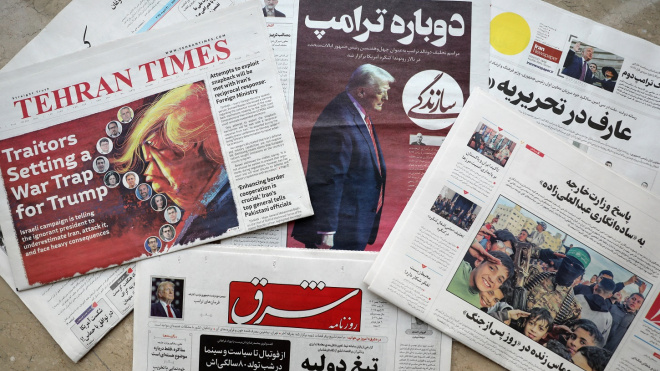
The Islamic Republic of Iran is facing an unprecedented confluence of internal dissent and external pressure, leading many observers to question whether the ruling regime of the ayatollahs is nearing its breaking point. From the streets of Tehran to the geopolitical chessboards of Washington D.C., the signs point to a profound and escalating crisis, casting a long shadow over the future of a system established in 1979. The United States, acutely aware of the growing weakness of Iran's ayatollahs, has redoubled its efforts to press Tehran, believing that the regime's grip on power, both domestically and regionally, is slipping.
Experts and international leaders alike suggest that this current wave of unrest is different. Unlike previous protests, which often sought reform, the present movement demands fundamental change, fueled by a relentless economic crisis and a deep-seated disillusionment with theocratic rule. Coupled with the erosion of Iran's carefully constructed regional security apparatus, these internal fractures present a formidable challenge to the regime's survival, propelling the nation towards an uncertain, potentially transformative, future.
The Unprecedented Wave of Internal Dissent
Iran is currently engulfed in its most extensive and vociferous popular protests since the Islamic Revolution of 1979. What distinguishes these demonstrations from prior waves of unrest is their sheer breadth and depth. The current revolt transcends typical social and economic divides, uniting men and women, students and workers, and members of diverse ethnic and regional groups across the country. This widespread participation underscores a national consensus that the existing system is untenable.
At the core of this popular uprising is an "interminable economic crisis" that has crippled the lives of ordinary Iranians, exacerbated by years of sanctions and systemic corruption. Beyond financial hardship, there is a profound "hastío con el sistema teocrático"—a deep weariness and exhaustion with the theocratic system itself. This sentiment is critical because it has fundamentally shifted the demands of the protesters. Where previous movements might have called for reforms within the existing structure, the current demonstrations are unambiguous: they call for the outright "end of the regime of the ayatollahs."
The regime's response has been brutal, deploying extreme violence to quell the unrest. Reports indicate at least 2,000 deaths, a stark testament to the ferocity of the repression and the regime's desperate attempt to maintain control. This heavy-handed approach further illustrates the weakness of Iran's ayatollahs, as their reliance on force betrays an inability to address the root causes of the widespread discontent through legitimate means. The leadership perceives its power "slipping through its fingers," yet lacks a single internal enemy to blame, leading it to consistently demonize the U.S. and Israel as orchestrators of the rebellion.
Erosion of Iran's Regional Influence: A Collapsing Shield
Beyond its internal struggles, Iran's strategic regional shield, meticulously built over decades, is showing significant cracks, contributing massively to the perceived debilidad ayatolás irán. For over thirty years, the regime's strategy, initiated by Supreme Leader Ali Khamenei, involved projecting power through a network of loyal militias and armed groups across the Middle East. This approach, spearheaded by the elite Quds Force of the Islamic Revolutionary Guard Corps under the command of General Qasem Soleimani, was cost-effective and provided deniability, allowing Iran to advance its interests—primarily against Israel and the U.S.—without direct military engagement.
However, in the last two years, this network has been severely weakened. Key military partners have been decimated or collapsed. While the exact timeline can be debated, the once formidable Assad regime in Syria has been profoundly destabilized and is often considered to have lost significant functional independence. Similarly, groups like Hamas and Hezbollah, critical components of Iran's "arc of influence," have faced unprecedented challenges. The 2023 incursion by Hamas against Israel, while seemingly an act of strength, ultimately led to a devastating conflict that has severely degraded the group's capabilities and drawn international scrutiny to the entire proxy network.
The assassination of Qasem Soleimani in 2020 by a U.S. drone strike in Baghdad was a monumental blow to this network. Soleimani, described as "the greatest architect of an arc of influence that extends from the Gulf of Oman through Iraq, Syria, and Lebanon to the eastern shores of the Mediterranean," was the operational genius behind coordinating financing, weapons, and political-military advice to these proxy groups. His death created a vacuum that Tehran has struggled to fill, significantly impairing the efficiency and cohesion of its regional strategy. The ongoing struggles of these groups directly underscore The Collapse of Iran's Proxy Network: A New Era of Vulnerability, leaving the regime more exposed than ever.
US Pressure and the Intensifying External Squeeze
The United States has consistently escalated its pressure on Iran, particularly under various administrations. Donald Trump, for instance, frequently reiterated threats of large-scale attacks, symbolizing a robust policy of deterrence and economic strangulation. This sustained external pressure compounds the internal difficulties faced by the regime. Washington's strategy recognizes that Iran's internal fragility, coupled with its diminishing regional influence, creates a unique window of opportunity to push for change.
The U.S. approach isn't solely military; it involves a sophisticated mix of sanctions, diplomatic isolation, and support for civil society movements. While Iran's regime attempts to deflect blame by portraying the protests as foreign-instigated conspiracies, the reality is that deeply rooted grievances about economic hardship and lack of freedom are the primary drivers. However, the external pressure acts as an accelerant, limiting the regime's resources and compounding its governance challenges. The context of international sanctions, for example, cripples Iran's ability to finance its proxies or invest in its domestic economy, further alienating its populace and exacerbating the debilidad ayatolás irán.
Moreover, the shifting geopolitical landscape, where traditional adversaries are increasingly aligning (such as the Abraham Accords), further isolates Tehran. This creates a difficult operating environment for Iran, forcing it to expend significant resources to maintain its regional position, even as its domestic foundation crumbles. The regime's desperate invocation of external enemies often rings hollow to a population more concerned with bread-and-butter issues and basic human rights.
A Desperate Grip: The Ayatollahs' Struggle for Survival
The current situation presents the Islamic Republic with its most severe test since its inception. The combination of widespread, ideologically driven internal protests and the systemic weakening of its regional security architecture creates an existential dilemma for the ruling clerics. The brutal repression, with thousands of casualties, is not merely a tactic; it is an overt manifestation of the regime's paranoia and its perceived loss of control. The leadership understands that what began as localized grievances has evolved into a nationwide movement demanding fundamental change, posing an existential threat.
One critical factor hindering an immediate collapse, paradoxically, is the lack of a unified, solid alternative to replace the existing system. While the protests are broad and deep, a clear, widely accepted opposition leader or structure has yet to emerge. This vacuum allows the regime to cling to power, even as its legitimacy erodes. However, this absence of a clear successor also represents a dangerous instability, as any abrupt collapse could lead to prolonged chaos or civil strife, a scenario many regional and international actors dread.
The question is not if, but when, the cumulative pressure of internal dissent and external coercion will reach a critical mass. The regime, aware of its weakening position, continues to project strength and blame external forces, but the palpable fear in its violent responses suggests a deep-seated vulnerability. The trajectory indicates that the ayatollahs are indeed on shaky ground, facing a struggle for survival against mounting odds. This ongoing internal crisis is precisely why understanding the weakness of Iran's ayatollahs is paramount for anyone observing regional stability.
Conclusion
The current climate surrounding Iran paints a picture of a regime under siege, both from within and without. The widespread protests, driven by economic despair and a profound disillusionment with theocracy, signal a populace that no longer seeks mere reform but outright systemic change. This internal unrest is amplified by a concerted U.S. pressure campaign and the significant weakening of Iran's long-standing network of regional proxies. While the regime of the ayatollahs has shown remarkable resilience in the past, the confluence of these severe challenges suggests a tipping point may be approaching. The ultimate "end game" remains uncertain, clouded by the regime's brutal grip and the absence of a clear alternative, but the signs of profound debilidad ayatolás irán are undeniable, marking a pivotal moment in the nation's history.